Understanding Samaná’s seasonal wildlife
Humpback Whales in Samaná: Migration, Calves and What You May See
Discover why humpback whales visit Samaná, how their seasonal journey connects the Caribbean with northern feeding grounds, and what mothers, calves and surface behaviour can teach you during an encounter.
Why do humpback whales come to Samaná?
Samaná Bay is part of the Caribbean habitat used by North Atlantic humpback whales during their reproductive season. Courtship, mating and caring for young give this part of their annual journey a different purpose from time spent feeding farther north. Understanding that difference makes an excursion more interesting: the whales are here as wild animals using an important habitat, rather than appearing for a scheduled display.
Keep the geography clear. A day on Samaná Bay is not the same journey as a visit to the offshore Silver or Navidad banks. Those places belong to a wider Dominican whale landscape but involve different locations and arrangements. Use the Samaná whale-watching guide for the practical questions about the bay, departures and current operating season; this article focuses on understanding the animals you may encounter.
A migration connects the Caribbean with northern feeding grounds
North Atlantic humpbacks move between productive feeding areas at higher latitudes and warmer breeding areas in the Caribbean. Their journey links places that feel very different to a visitor: northern waters where food is an important focus and tropical waters associated with reproduction and young calves. It is a seasonal pattern across a population, not evidence that every whale starts from the same coast or follows an identical route.
Individual arrivals, departures and movements vary. A date on a travel calendar cannot tell you which animals will be in view on a particular day. Our guide to the best time to visit Samaná places the whale season within a wider holiday. Distinguish the biological season from the permitted dates and actual departures that must be confirmed for your year of travel.
Mothers and calves: look for a relationship, not a spectacle
A calf is a young whale that depends on its mother, including for milk. Seeing a smaller whale close to a larger one can be an opportunity for the guide to explain the relationship and the care that young animals need. Do not assume every pair is a mother and calf, or identify sex, age and family roles from size alone. Ask what the guide can establish from the observations rather than turning a brief surface view into a complete story.
The presence of calves in the region does not mean an excursion will witness a birth or find a particular family. For children, the journey and the need to breathe at the surface can be more useful starting points than a promise of jumping whales. The Samaná family planning guide covers the separate question of whether the boat, boarding and complete outing suit your children.
Breathing and surfacing: the first signs to recognise
Whales are mammals and breathe air. A blow at the surface is an exhalation, not water being pumped out of the animal’s stomach. You may notice the blow before seeing a back or dorsal fin. Watch the area the guide indicates, while leaving yourself time to look with your own eyes rather than spending the entire encounter trying to locate the animal on a phone screen.
A sequence of surfacing and submerging is already behaviour worth noticing. Pay attention to the direction, the shape of the back and how much of the animal is visible. Do not infer distress, friendliness or an invitation to approach from one movement. The captain and guide need to assess the animals and the surrounding vessels, and a passenger’s sighting does not determine where the boat should go.
Tail lifts, flukes and dives
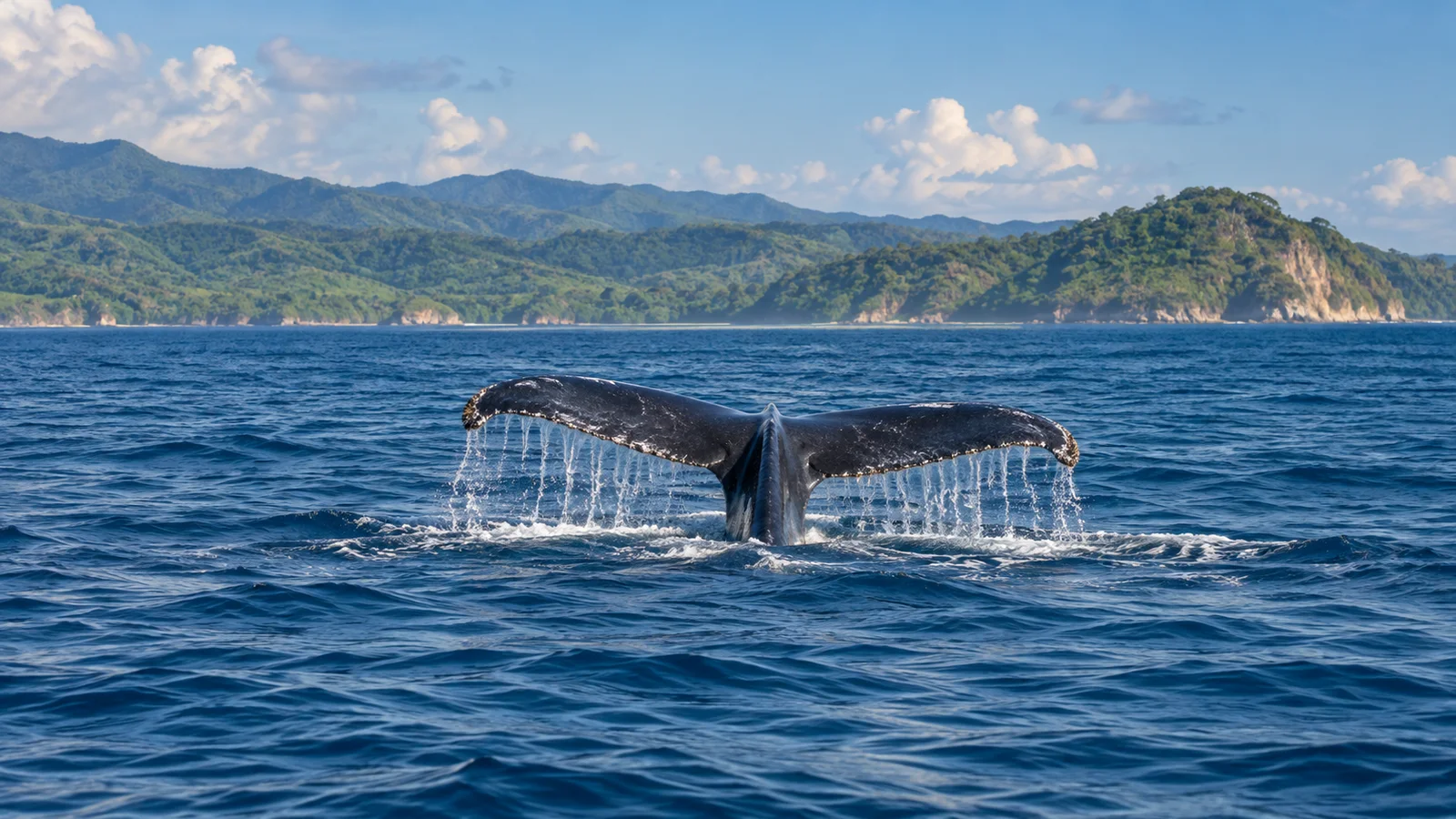
The two lobes of the tail are called flukes. Sometimes they rise above the surface as a whale dives; sometimes a whale submerges without giving you that view. A tail lift is a useful feature to recognise, not a required ending to every surfacing. Let the guide explain what is visible and avoid treating an interval underwater as a countdown to a predictable next appearance.
Markings and the shape of the underside of the tail help researchers recognise individual humpbacks through photographs. That does not mean every holiday image is sufficient to identify an animal. If a clear photograph interests you, ask the guide what details are useful, without requesting a closer approach or delaying the vessel’s decisions to obtain it. A distant observation can still be a worthwhile record of the encounter.
Breaches and surface displays are possibilities, not inclusions
A breach is a leap in which a whale lifts part of its body out of the water. Humpbacks can also strike the surface with their long pectoral fins or their tails. These conspicuous movements are part of the species’ range of behaviour, but their presence in a photograph or a tour description does not mean they will occur on your departure. Avoid judging the whole experience by whether you see a leap.
Descriptions such as playing, waving or putting on a show can make an image memorable, but they are not reliable explanations of an individual animal’s motivation. Describe what you actually saw first: which body part moved, how the whale surfaced and what the guide observed around it. That distinction keeps the experience fascinating without claiming to know why every splash occurred.
Whale song belongs to an underwater soundscape
Male humpbacks produce elaborate songs, an important part of the species’ acoustic behaviour. Song is different from a blow at the surface and should not be imagined as a sound every passenger will hear clearly from the deck. Much of the animals’ activity takes place beyond what a short surface encounter lets us see or hear.
Listening underwater requires appropriate equipment and suitable arrangements. Ask whether a particular departure offers an acoustic listening element before treating it as part of the experience. Do not infer that a hydrophone is provided from a general reference to singing whales. A trip without a listening session can still offer thoughtful interpretation of what is happening above and below the surface.
A quiet encounter can still be memorable
There is value in watching an animal travel, breathe and disappear beneath the water without an obvious surface display. A calm sequence may leave you remembering the scale of a back, the sound of a breath or how difficult it is to follow an animal once it submerges. Those observations belong to a real wildlife experience just as much as a dramatic photograph does.
Ask the guide to distinguish what is observed from what remains uncertain. A useful explanation can connect an ordinary surfacing with the whale’s life in the region, while acknowledging the limits of the view. Before boarding, decide whether your interest is in the animals or in reproducing a particular image. Photography can be part of the visit without setting the measure of success for everyone on the boat.
Understanding the animals means giving them space
A breeding habitat is also a place where human activity needs restraint. Choose an operation that explains the applicable local rules and follows the captain’s decisions about approach, observation and departure. Keep mother–calf relationships and the animals’ movements in mind when a vessel waits or moves away. More time beside an animal and a closer photograph are not automatically better outcomes.
Follow the crew’s instructions and do not ask for chasing, touching or entering the water with the whales during a Samaná Bay observation outing. Rules and permitted activities in another country or an offshore destination should not be substituted for the arrangements here. Ask about current local requirements when booking, rather than relying on a distance or interaction described for somewhere else.
Connect wildlife interest with a realistic visit
Use what you want to learn to shape your questions before booking. Ask who interprets the encounter, which vessel is proposed, where it departs and how the outing handles changing conditions. Share children’s ages and any boarding or comfort needs. Educational interest does not remove the practical demands of time on a moving boat, and an operator’s wildlife knowledge is only one part of choosing a suitable departure.
The Samaná whale-watching tour page is the relevant existing enquiry route. Confirm availability for the actual dates, the operating company, the boat and the services in writing. Ask about any island extension separately. A longer list of stops does not establish more time observing whales, and no proposal should turn a particular sighting or behaviour into a guaranteed inclusion.
Are the whales in Samaná humpback whales?
Humpbacks are the focus of Samaná’s seasonal whale-watching activity. Ask the guide to explain identifying features rather than treating every distant shape or splash as a confirmed identification. The name of the excursion describes its wildlife focus; it does not establish which animals you will encounter on a particular departure.
Will you see calves or jumping whales?
You may encounter calves or surface displays, but neither should be promised. Different animals and conditions make different encounters possible, and a photograph from another day is not a forecast for yours. Choose the trip for responsible observation and interpretation, allowing quiet surfacing to be part of the experience.
Are sightings guaranteed?
No. These are free-ranging wild animals, and visibility, sea conditions and their movements affect what can be observed. Confirm the operator’s actual cancellation and weather arrangements without confusing those commercial terms with a biological guarantee. Understanding the whales adds meaning to an encounter; it does not make one certain.
Meet Samaná’s whales with curiosity and realistic expectations.
Explore the seasonal whale-watching experience, then confirm your dates, departure, group needs and the services included in the proposal.
Explore Samaná experiences